Unified Single-Vendor SASE

SD-WAN and Security, Unified in One Platform

Integrate SD-WAN, cloud security, and zero trust access in one Aruba platform to simplify operations, boost performance, and protect users everywhere.
Enterprise network architectures were designed for a world where applications lived in centralized data centers and users worked from corporate offices. Today, applications are distributed across SaaS platforms, public clouds, and regional data centers, while employees, partners, and contractors access these systems from virtually anywhere. At the same time, organizations must defend against increasingly sophisticated cyber threats while supporting bandwidth-intensive applications and a growing number of connected devices.
Traditional WAN and security architectures struggle to keep pace with these changes. Backhauling traffic through centralized data centers introduces latency, increases cost, and creates operational complexity, while fragmented security tools make it difficult to enforce consistent policies or maintain visibility across the environment. As a result, many organizations are reevaluating how networking and security should be delivered in a cloud-first world.
By modernizing both WAN and security architectures through SASE, organizations can enable direct, secure access to applications and services across on-premise infrastructure, public cloud environments, and SaaS platforms—regardless of where users or devices are located.
At Hararei, we understand that adopting a modern infrastructure architecture is a strategic journey. Our team helps organizations plan, implement, and operate these cloud-generation networking and security technologies with a structured and pragmatic approach.
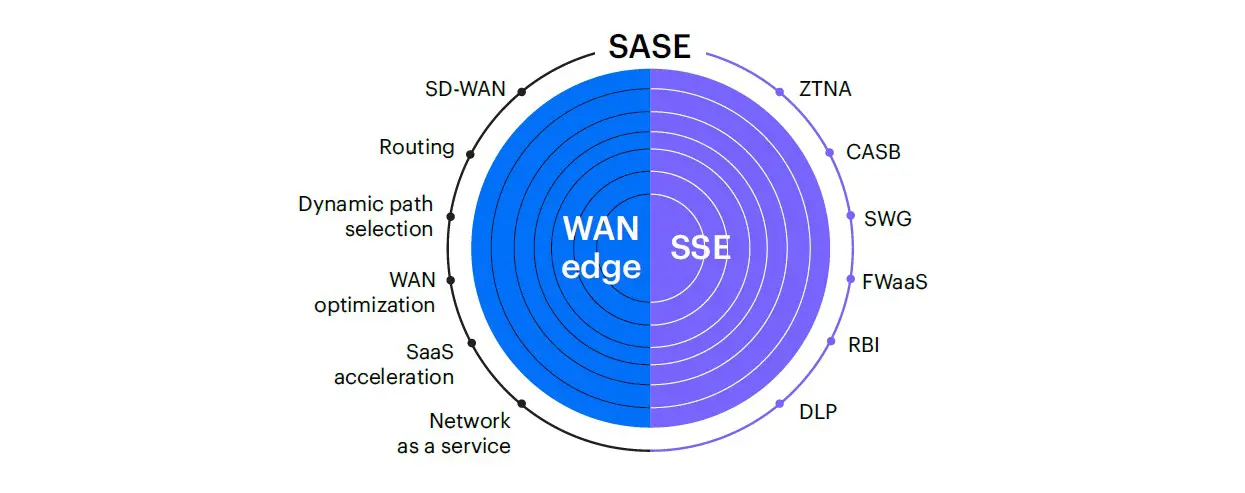
What Is SASE?
Secure Access Service Edge (SASE) combines an advanced SD-WAN edge deployed at branch locations with a comprehensive, cloud-delivered Security Service Edge (SSE) platform that provides integrated networking and security capabilities.
Choosing Between Single-Vendor and Best-of-Breed
There is no universally correct answer. The right SASE architecture depends on your organization's priorities, existing environment, and operational model. That said, there are clear indicators that point toward one approach over the other.
Single-vendor SASE tends to be the better fit when:
- Your primary goal is simplifying operations — fewer vendors, fewer consoles, fewer integration points to maintain
- Your networking and security teams are unified, or you want to move in that direction
- You are starting fresh or undergoing a full WAN and security refresh simultaneously
- Your organization values a single support relationship and clear accountability
- You want to move quickly — a single-platform deployment typically requires less integration work and can be operational faster
Best-of-breed tends to make more sense when:
- You have existing investments in specific security or networking technologies that are performing well and aren't due for replacement
- Your security requirements demand capabilities that no single vendor currently covers adequately
- You have the operational maturity and staffing to manage and integrate multiple platforms effectively
- Different parts of your organization have distinct networking or security requirements that a single platform cannot address uniformly
For a detailed look at the technical capabilities of the HPE Aruba Networking unified SASE platform, download the overview brochure.
Our position. We work with both architectures and have no preference other than what's right for your situation. If a single-vendor approach fits, Aruba's platform is one of the most capable available. If best-of-breed is the better answer, we can design and implement that too.
What Single-Vendor SASE Delivers
A single-vendor SASE solution combines SD-WAN and Security Service Edge (SSE) capabilities within a unified platform — managed through a single console, governed by a single policy engine, and supported by a single vendor relationship.
The practical benefits of this approach are significant:
- Consistent policy enforcement. Because networking and security are managed in one place, policies follow users and devices regardless of where they are or how they connect. There's no need to synchronize rules across separate platforms or reconcile gaps between them.
- Simplified operations. A unified management console reduces the day-to-day overhead of running separate networking and security stacks. Teams spend less time correlating data across systems and more time acting on it.
- Better visibility. With a shared data plane, traffic and security events are correlated natively. This gives operations teams a clearer, more complete picture of what's happening across the environment without having to stitch together logs from multiple vendors.
- Faster troubleshooting. When something goes wrong, a single-vendor architecture eliminates the finger-pointing that can occur between separate networking and security vendors. One platform, one support engagement.
- Lower total cost. Consolidating onto one platform typically reduces licensing complexity, eliminates redundant capabilities, and lowers integration and management overhead over time.
Single-vendor SASE is particularly well suited to organizations that are modernizing their WAN and security architectures simultaneously, want to reduce operational complexity, or are moving away from a fragmented set of point solutions toward a more unified infrastructure model.
The Aruba Single-Vendor SASE Platform
Aruba's SASE platform brings together SD-WAN and Security Service Edge capabilities in a unified architecture, managed through a single cloud-based console
SD-WAN — EdgeConnect
Aruba EdgeConnect is the WAN edge component, deployed at branch locations and data centers. It provides application-aware routing, WAN optimization, and traffic steering across multiple underlay transports *mdash; broadband, LTE, MPLS — with automatic failover and path selection based on real-time link quality. EdgeConnect replaces traditional branch routers and WAN appliances while delivering significantly better application performance and visibility.
Security Service Edge (SSE)
The SSE component delivers cloud-based security services that protect users and devices regardless of where they connect from:
- Secure Web Gateway (SWG) — inspects and filters internet-bound traffic, blocking malicious content, enforcing acceptable use policies, and providing SSL inspection
- Cloud Access Security Broker (CASB) — provides visibility and control over SaaS application usage, enforcing data loss prevention policies and detecting shadow IT
- Zero Trust Network Access (ZTNA) — replaces traditional VPN with identity and context-aware access to applications, ensuring users only reach what they are explicitly authorized to access
- Firewall-as-a-Service (FWaaS) — delivers consistent firewall policy enforcement across all locations and users without requiring on-premise appliances
Unified Management
Both the SD-WAN and SSE functions are managed throughone portal, providing a single view of network performance, security events, and policy across the entire environment. This eliminates the operational overhead of maintaining separate management planes for networking and security.
How Hararei Helps
Deploying SASE is not a product purchase — it's an architectural shift that touches networking, security, identity, and operations simultaneously. Getting it right requires more than just technical capability; it requires a structured approach and experience across a wide range of enterprise environments. Hararei has been designing and deploying SASE architectures for more than eight years. We bring that experience to every engagement through a consistent, pragmatic delivery model:
- Assessment and design. We start by understanding your current environment — existing WAN architecture, security tools, cloud footprint, and operational model. From there we develop a target architecture and migration plan that accounts for your constraints, timelines, and business priorities. We don't start with a product recommendation; we start with your requirements.
- Implementation. Our certified engineers handle the full deployment — EdgeConnect at branch and data center locations, SSE configuration, identity integration, and policy definition. We manage the project end to end, coordinating with your internal teams and any third parties involved.
- Migration and cutover. Moving from a legacy WAN and security architecture to SASE requires careful sequencing. We plan and execute the migration in phases to minimize disruption, with rollback options at each stage.
- Day 2 support. Our involvement doesn't end at go-live. We offer ongoing operational support — monitoring, tuning, policy updates, and troubleshooting — to ensure the environment continues to perform as your business evolves.
- Strategic advice. As part of every engagement, we provide Level 4 strategic guidance — helping you think through not just the immediate deployment but the longer-term architecture decisions that will shape your infrastructure over time.
Ready to Evaluate SASE for Your Organization?
Every organization's path to a modern network and security architecture is different. Whether you are at the early stages of evaluating options, working through a business case, or ready to begin a deployment, we are happy to have a straightforward conversation about your requirements and what an appropriate architecture might look like.
There is no obligation and no sales pitch — just an honest discussion about whether SASE makes sense for your situation, and if so, how to approach it.
Contact Us Please contact Hararei for an in-depth discussion on using any of our Cloud or Cybersecurity products or services